Magazine
Retrograde contamination: causes, risks & solutions

Retrograde contamination refers to the contamination of a water supply system originating from the point of use – in other words, against the direction of water flow. During this process, bacteria and germs can enter the outlet of fittings or the interior of water filters from the outside, for example through splash water, and thus potentially reach the drinking water pipes.
If people then come into contact with these bacteria and germs, it carries the risk of infection – consequently, it is essential to prevent retrograde contamination.
In this article, we explain how you can effectively prevent retrograde contamination through technical solutions and proper handling.
Drains and siphons as a source of retrograde contamination
The greatest danger of retrograde contamination exists from:
- Splash water from the drain or
- Aerosols rising from the drain.
This is because water-borne bacteria from the drain can be transferred to the wash area, and rising aerosols can enter the indoor air within a radius of up to 1.5 metres around the washbasin.
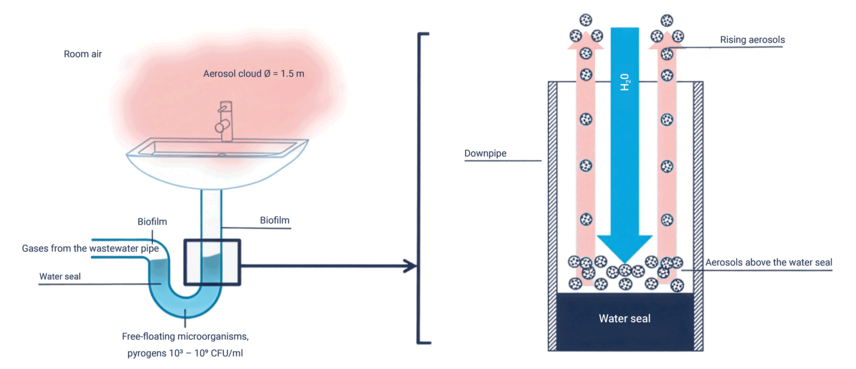
Therefore, the water jet should never fall directly into the drain!
In the article "HygieneSiphon stops the rise of aerosols from drain outlets", we explain the role that siphons and drainage pipes can play in outbreaks of nosocomial infections and how infection outbreaks can be prevented.
Water filters as a source of retrograde contamination
In the event of germ contamination of tap water, water filters are often installed as an immediate measure to effectively retain these germs. However, water filters are also subject to the risk of retrograde contamination.
There are various ways to keep this as low as possible.
Bacteriostatic water filters and bactericidal materials
The addition of a bacteriostatic additive in the plastic of the filter housing, for example, prevents the growth of germs. Such an active ingredient ensures that pathogens cannot multiply further on the filter housing by blocking an essential part of the organism's new formation.
In addition, the water outlets can be equipped with a bactericidal material which actively offers protection against germs. Due to the bactericidal effect, silver or copper, for example, have proven effective for these coatings on the water outlets.
Did you know? Our filters Baclyser® neo T and our Baclyser® S offer the best retrograde protection through the antibacterial MetalSkin® coating.
Proper handling of water filters
In addition to the protection provided by the bacteriostatic material, proper handling of the water filters is of great importance:
- You should not touch the filter at the outlet.
- Contact of the filter outlet with dirty water or greywater should be avoided.
- You should not clean the filters.
- In the event of heavy visible contamination, such as blood or mucus, the filter should be changed immediately.
- An immediate change should also take place in the event of visible damage.
- People in facilities equipped with filters must be thoroughly informed about the handling of medical devices.
To counteract retrograde contamination, it is also important to replace the filters regularly according to the manufacturer's instructions.
With proper handling, the risk of retrograde contamination of a filter within the specified service life is to be classified as minimal.
Retrograde contamination in dental practices
In dental practices, there is an increased risk of retrograde contamination of dental instruments due to backflow of saliva, blood, or wound secretions. These can enter the water-carrying pipes through the devices. The consequence: the next patient receives contaminated water.
Aerosols from suction systems can also infect open water systems.
To ensure that patients are not exposed to a risk of infection from possible retrograde contamination, appropriate measures must be taken. The HTM 01-05 (Health Technical Memorandum) for dental excellence in the UK recommend, for example, flushing the water-carrying systems for at least 20 seconds between each patient. Furthermore, the backflow of fluids should be prevented by using appropriate anti-retraction valves.
Conclusion: Safety at the point of use is controllable
Retrograde contamination poses a risk to water hygiene, as it endangers the drinking water quality directly at the point-of-use.
However, as we have shown, this danger can be effectively controlled through a combination of modern technology and conscious action – if required, we will be happy to advise you.