Magazine
Audits at Aqua free - Insights
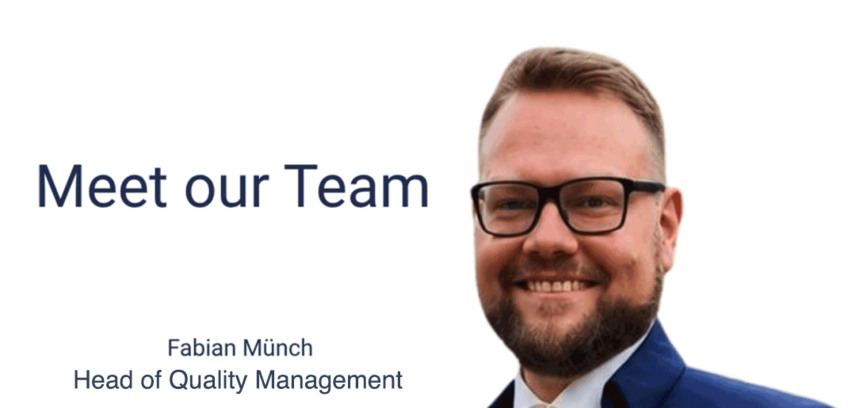
Interview with the Head of Quality Management
Interviewer: Thank you for taking the time to talk to us today about certifications and audits at Aqua free.
Fabian Münch: It is my pleasure. I am delighted to share my experiences.
Interviewer: Let us start with a fundamental question. Can you explain the significance of the ISO 9001, ISO 13485 and ISO 14001 certifications for Aqua free?
Fabian Münch: Certainly. The ISO 9001 certification represents comprehensive quality throughout our company. It is an internationally recognised standard for quality management systems.
ISO 13485 is particularly relevant for us as a medical equipment manufacturer and focuses on the safety and quality of our medical equipment. ISO 13485 increases the requirements for a quality management system beyond those of ISO 9001.
In contrast, ISO 14001 relates to our sustainability efforts and challenges us to manufacture our products in a more environmentally friendly manner, thereby making our production processes more sustainable.
Interviewer: How exactly does an audit as part of these standards work?
Fabian Münch: An audit is basically the same as a TÜV inspection. It assesses whether a company operates in compliance with established standards as well as legal requirements and objectives.
Audits take place annually, with random checks performed over a period of two years and re-certification with full monitoring every third year.
An audit confirms and documents that we adhere to established quality standards, comply with them fully and manufacture our products accordingly. For each audit, the inspection body assigns certified auditors who objectively and impartially assess our system against the respective standards.
Interviewer: What does a new certification process look like?
Fabian Münch: A new certification process is carried out in two steps. Step 1 involves checking all the system-relevant documents. This includes, for example, the management manual and the associated standard operating procedures or work instructions.
In Stage 2, these and further documents belonging to the system (such as forms and records) are examined on site by an auditor over several days and cross-checked with reality, for instance in production or development. The main objective here is to demonstrate that the procedures and processes are adhered to and actively practiced as described.
Should any non-conformities occur, these are rectified and verified with the auditor. A corresponding certificate is only issued once all identified non-conformities have been addressed and resolved.
Interviewer: Why are these certificates so important for Aqua free, especially in the medical sector?
Fabian Münch: Medical devices, such as our water filters for medical areas, are subject to strict monitoring. Certification in accordance with ISO 13485 forms the baseline that allows us to sell medical devices in the first place. At the same time, certification serves as a seal of quality, ensuring transparency and safety for our customers.
Through our certification, we demonstrate that production is monitored, traceability is guaranteed, and our personnel are qualified. Additionally, this includes the monitoring of our suppliers—all measures to ensure that customers can trust they are receiving the expected quality.
Interviewer: Can you tell us something about how you prepare for an audit?
Fabian Münch: An effective system should always be available for an audit. When preparing for an audit, I compare key figures and check whether we have achieved our targets.
Roughly four months before the external audit, I go through all the key documents and standard specifications together with an external auditor. We refer to this process as an internal audit, which can always be carried out by an in-house member of staff trained to do so.
Interviewer: Finally, could you tell us something about CAPA (Corrective Action and Preventive Action) and the importance of ISO 9001 within the context of opportunities and risks at the company?
Fabian Münch: CAPA defines how our company develops, how it addresses problems to resolve them effectively (corrective action) while also ensuring that they cannot recur in the future (preventive action) across various areas and developments. CAPA thrives on a positive error culture. When we address challenges openly and analyse their root causes, we can eliminate these causes and achieve sustainable growth as a company.
Within the framework of ISO 9001, opportunities and risks for the company, our products, and our quality management system are analysed in order to derive suitable measures. The goal is twofold: to continuously question ourselves and respond to risks, while also seizing opportunities to remain a future-proof company that stands for quality.
Interviewer: Thank you for this insightful information.
Fabian Münch: You are welcome. It was my pleasure.