Magazine
Water stagnation – a hygiene problem

Stagnant water is water that does not move and stands in the pipes. This is a potential problem and should be surveyed critically, since not all water is the same.
What is water stagnation exactly? Where does it occur, what risks does it imply and how to avoid it? Read on to get all the answers to these questions.
What is water stagnation?
Stagnant water is water that has been standing still in the drinking water system from the building connection to the faucet for more than 4 hours. This provides the ideal conditions for water bacteria to form biofilms.
Once flow is reduced or absent, the conditions within the system begin to shift. Water age increases, temperatures begin to drift, and the hydraulic forces that normally act on internal surfaces are reduced.
These changes do not initiate biofilm formation — biofilms are a natural and ubiquitous feature of water systems — but they significantly influence how they develop and persist.
In practical terms, this means that a water system affected by stagnation is no longer behaving only as engineered pipework. It has become, in part, a biological habitat.
Water quality: an underestimated factor
If we were to take all the expert opinions of the Association of German Engineers, the German Technical and Scientific Association for Gas and Water, the German Federal Environment Agency and the Robert Koch Institute on the subject of the quality of drinking water, they would all boil down to a simple statement:
“Tap water has to flow.”
In the past, the issue of water quality was often underestimated. It was assumed that whatever came out of the tap was safe and clean. However, water is a delicate commodity: microbiological organisms such as legionella and other germs can have a considerable impact on its quality.
Standing water favours biofilm formation
The formation of stagnant water bacteria dangerous to our health occurs primarily in the domestic pipe system. Microorganisms and germs accumulate on the surface of water pipes, forming a biofilm, which is a layer of slime known an EPS (extracellular polymer structure), in which various microorganisms such as amoebae, Pseudomonas aeruginosa legionella embed themselves and cohabit.
Poorly insulated water pipes, hot water that is not hot enough or insufficient water flow provide the ideal living conditions for water bacteria to flourish.
Where does water stagnation occur most
Standing water occurs when water extraction points in buildings, flats and rooms are not used due to renovation work, vacancies, holidays, seasonal or too little use. Particularly affected facilities are schools, hotels, residential buildings, nurseries, hospitals, doctor’s offices, retirement homes and sport halls.

However, stagnant water is not only caused by not using water faucets. Also oversized water pipes with a decrease in use, dead legs or too much time between installation and commissioning of a pipe network can cause water stagnation.
What risks are associated with stagnant water?
As we’ve already discussed, water stagnation favours the formation of biofilms which provide the ideal living conditions for harmful water bacteria and germs, such as Pseuodomas aeruginosa and legionella. If water is tapped after a long period of stagnation, these pathogens can be released, posing a health risk to the user.
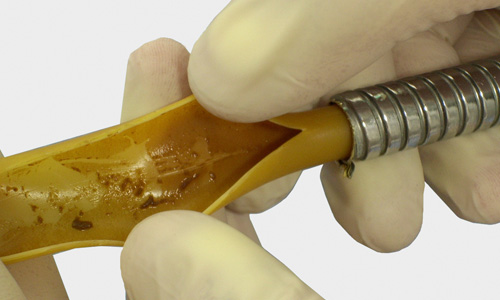
There is also a risk of contaminating the entire tap water system. If water stagnation occurs, the pipe section leading to the unused tapping point (branch pipe) will be the first to become contaminated. This backwards contamination can extend, meaning that the germs enter the entire pipe network and contaminate water tap points that were not primarily affected by stagnation.
How to avoid standing water
A widespread measure to combat stagnation is the regular, manual opening of all water taps to flush the pipes. The principle is simple: replace stagnant water with fresh water, restore the intended thermal and hydraulic conditions, and reduce the opportunity for microbial growth.
However, this comes with high labour costs, requires a long time and is usually a difficult procedure. Furthermore, there is a risk that the flushing process will not be carried out regularly.
Technical measures such as concealed ring supply systems and automatic washbasin taps ensure a regular flow of water in the pipe system.
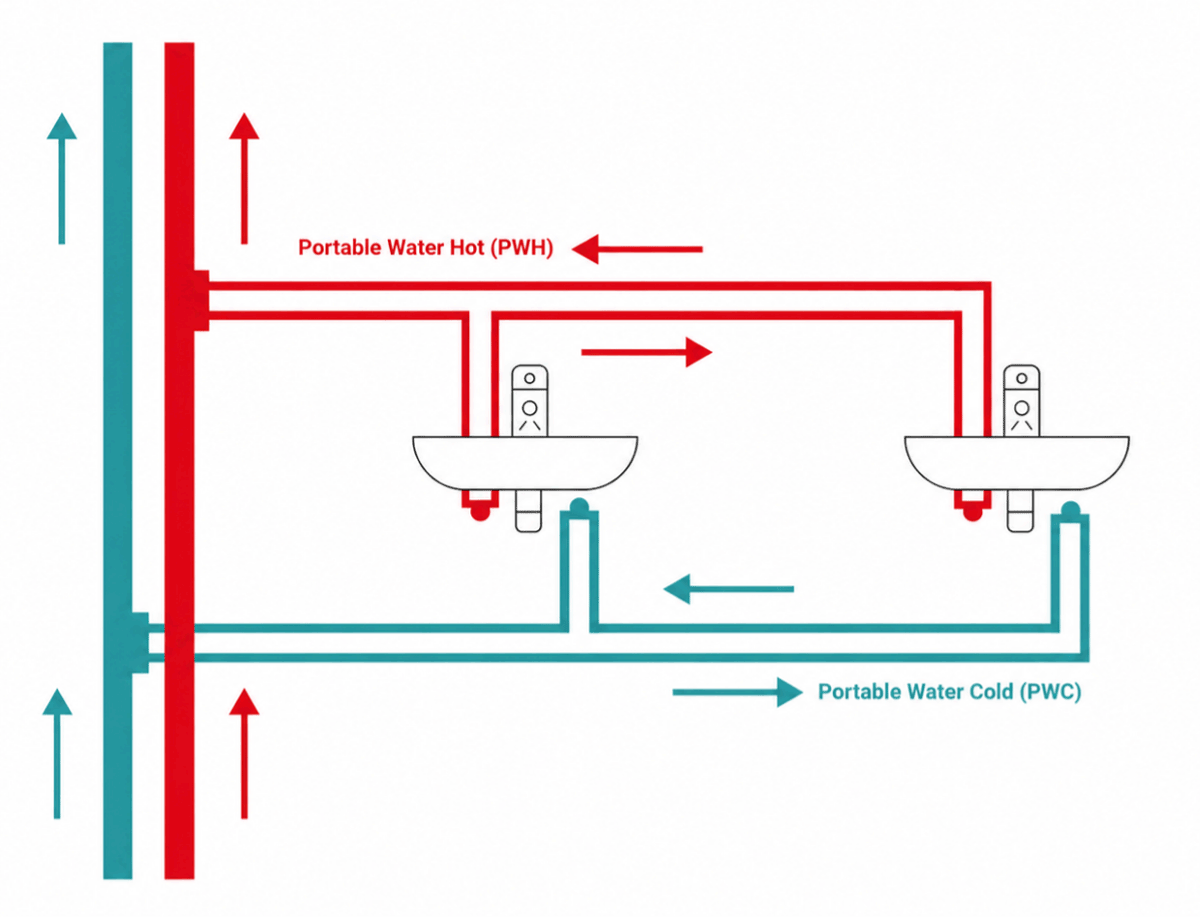
However, these systems are expensive to buy and install and can be problematic in facilities where stagnation can occur occasionally.
The need for design with no potential for stagnation
This is where design and operation intersect. Systems may be sized for demand that never materialises, include capacity for future expansion, or be affected by changing use. Components such as expansion vessels or dead ends can create areas of poor turnover, even where the wider system appears to function adequately.
That stresses the need for design with no potential for stagnation! That emphasis is important because it recognises a reality often missed in day-to-day discussion: stagnation is not always a maintenance problem that can be corrected later. Sometimes it is built into the way the system has been conceived, sized, or adapted.
It is also one reason why overly simple advice can be misleading. “Just flush it” may be useful as an immediate instruction, but it is not a strategic answer where the underlying issue is a system that no longer matches building use. In those cases, stagnation is a symptom of a deeper misalignment between design assumptions and operational reality.
Water filters and thermal disinfection to the rescue
If the pipes are contaminated, water filters for faucets and showers can be installed to provide immediate protection, since they stop harmful germs present in the pipe system.
Alternatively, the entire drinking water system can also be cleaned using thermal disinfection to remove dangerous bacteria and biofilms.
Subscribe to our newsletter
In our newsletter, we share interesting insights, tips, and news regarding water hygiene. Four times a year, Aqua free provides you with information on specialist and legal topics.